23-09-2024 | ZOOP observaties voor het Nieuwe Instituut door Frank Bruggeman i.s.m. Peter Zwaal
|
SNIJSELDERIJ
Helaas heeft de kerstomatenplant (Solanum lycopersicum var. cerasiforme), die in 2022 en 2023 in het zandbed langs de arcade van het Nieuwe Instituut opschoot, zich dit jaar niet vertoond. Misschien was het weer dit jaar minder gunstig. Misschien bevat het zandbed ter plaatse te weinig voedingsstoffen om nog een derde jaar achtereen tomatenzaadjes te laten ontkiemen. Volgend jaar maar eens wat zaadjes (of rijpe kerstomaten) op een andere plaats in het zandbed strooien om deze laatste hypothese te testen.
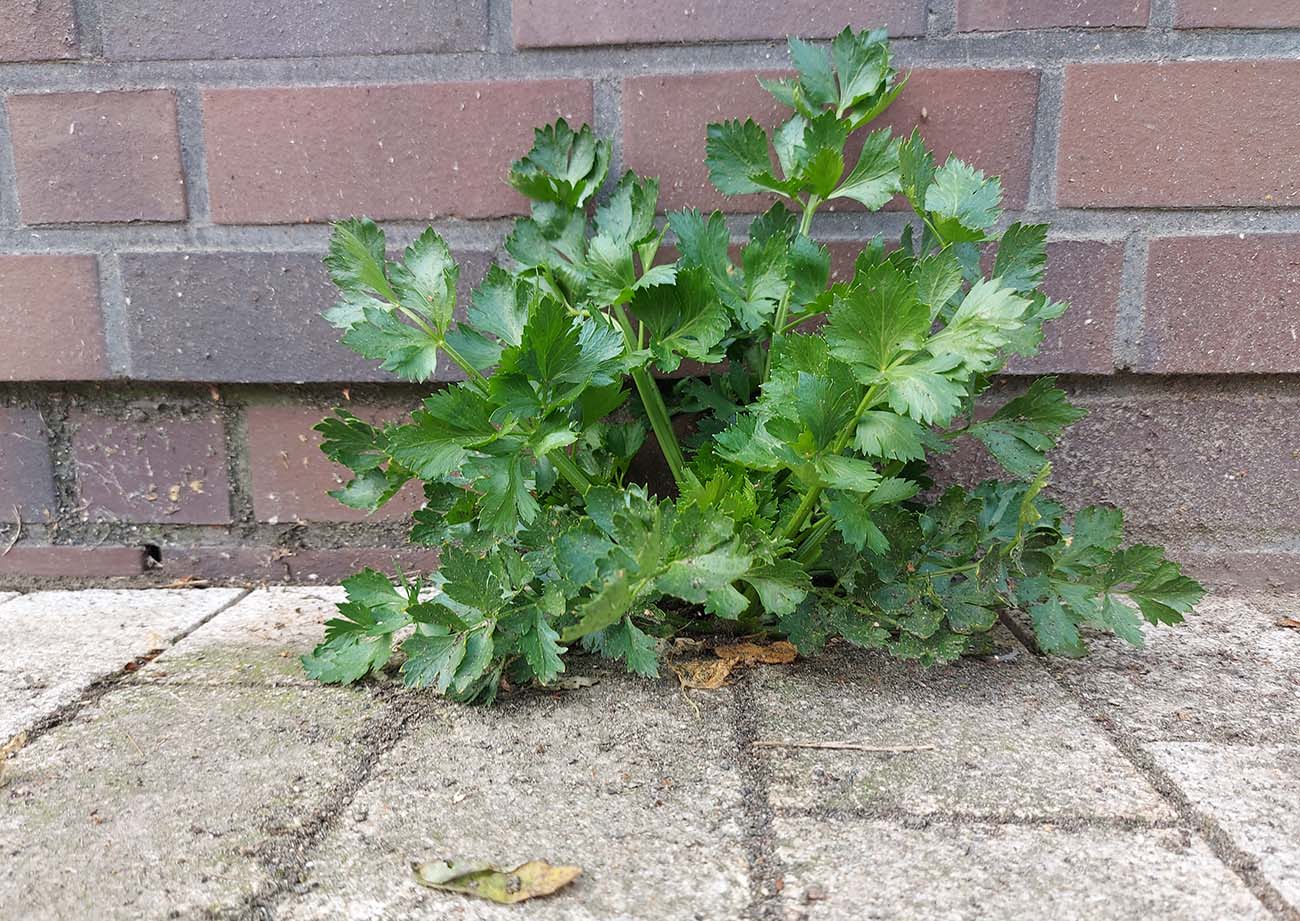
Bij het uittrekken van wat hoog opgeschoten gevelonkruiden langs de oostkop van het Nieuwe Instituut stuitte ik op een andere eetbare plant, namelijk snijselderij of groene selder (Apium graveolens var. secalinum). Dat is een tweejarige, wat betekent dat de plant volgend jaar nog flink wat in lengte zal toenemen en dan mogelijk ook zal gaan bloeien. Voorwaarde is natuurlijk wel dat er geen door de gemeente Rotterdam ingehuurde hovenier langskomt, die alles wat de stoep ‘ontsiert’ wegbrandt, of het nu eetbaar is of niet. Wat deze selderijplant met de kerstomaat gemeen heeft is dat het een onopzettelijke aangevoerde plant betreft. Biologen en botanici noemen dat adventiefplanten en ze vinden het vaak een uitdaging om te bedenken langs welke weg zo’n aangetroffen plant zich op een bepaalde locatie heeft weten te vestigen. Mijn meest plausibele verklaring in dit geval is dat er een selderijzaadje is meegelift in het profiel van een autoband of tuinlaars. Want de hoveniers die de perken langs de Jongkindstraat en het Museumpark onderhouden parkeren hun bedrijfsvoertuigen uitgerekend op deze plek. Maar echt weten doen we het natuurlijk niet, dus ook onwaarschijnlijker scenario’s mogen niet terzijde worden geschoven.
|
LEAF SELERY
Unfortunately, the cherry tomato plant (Solanum lycopersicum var. cerasiforme), which in 2022 and 2023 grew in the sand bed along the arcade of the Nieuwe Instituut, did not show itself this year. Perhaps because the weather conditions were less favorable. Perhaps because the sand bed contains not enough nutrients for tomato seeds to germinate for a third year in a row in the same exact spot. To test this last hypothesis I can sow some tomato seeds (or throw some ripe cherry tomatoes) in a different place in the sand bed next year. While pulling out some tall weeds along the east facade of the Nieuwe Instituut, I came across another edible plant, namely leaf celery (Apium graveolens var. secalinum). Celery is a biennial, which means that the plant will grow considerably in length next year and may then also flower. Provided, of course, that no gardener or municipal worker comes along and burns away everything that grows on the sidewalk, edible or not. What this leaf celery plant has in common with the cherry tomato is that it is an unintentionally introduced plant. Biologists and botanists call this adventitious plants and they often find it a challenge to figure out how such a plant has managed to establish itself in a particular location. My most plausible explanation in this case is that a celery seed hitched a ride in the tread of a car tire or garden boot. Because it happens that the gardeners who maintain the flower beds in this area often park their vehicles on this exact location. But of course we don’t really know, so more unlikely scenarios can not be discarded.
|