28-06-2024 | ZOOP observaties voor het Nieuwe Instituut door Frank Bruggeman i.s.m. Peter Zwaal
|
WILDE CICHOREI
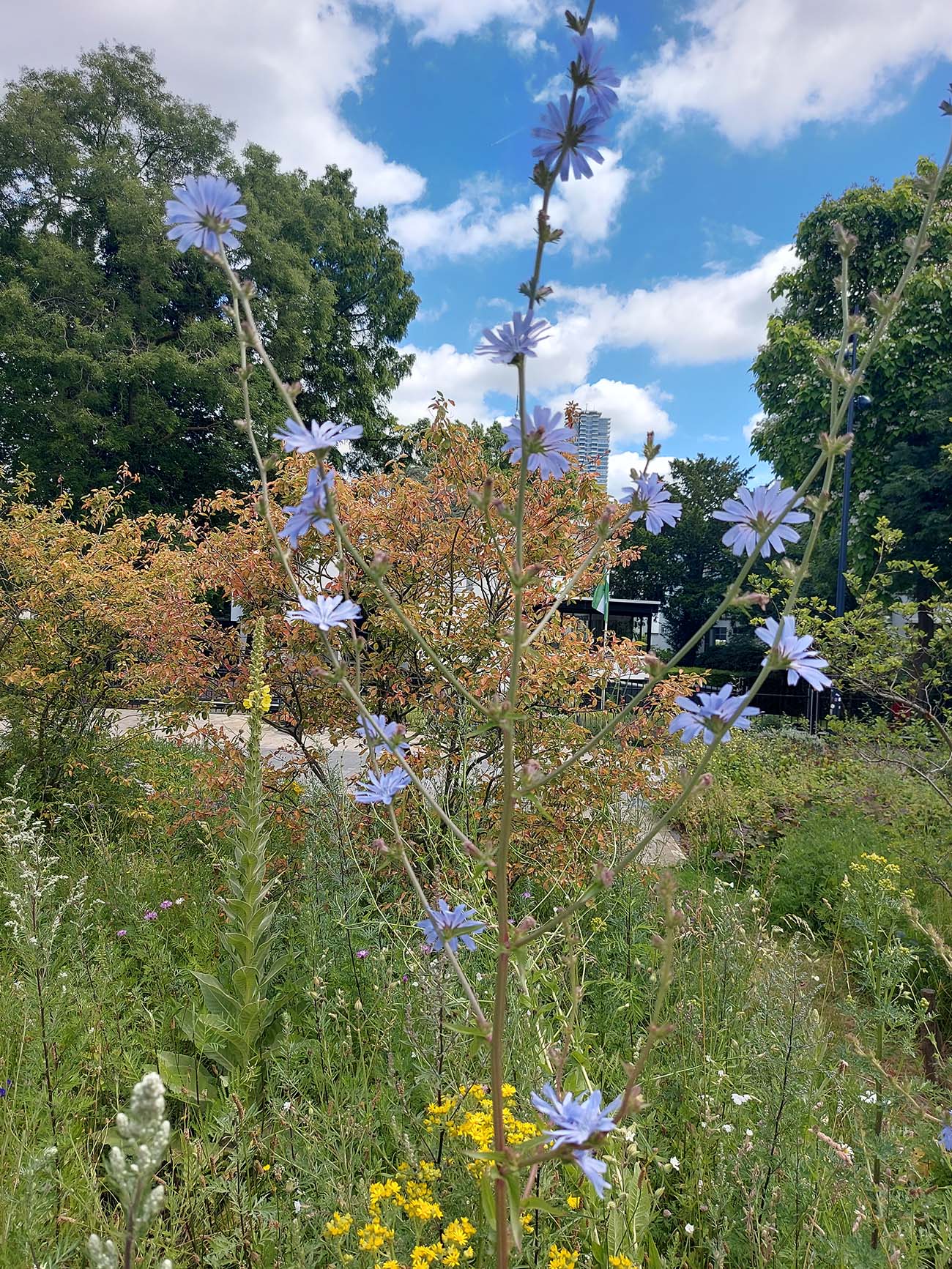
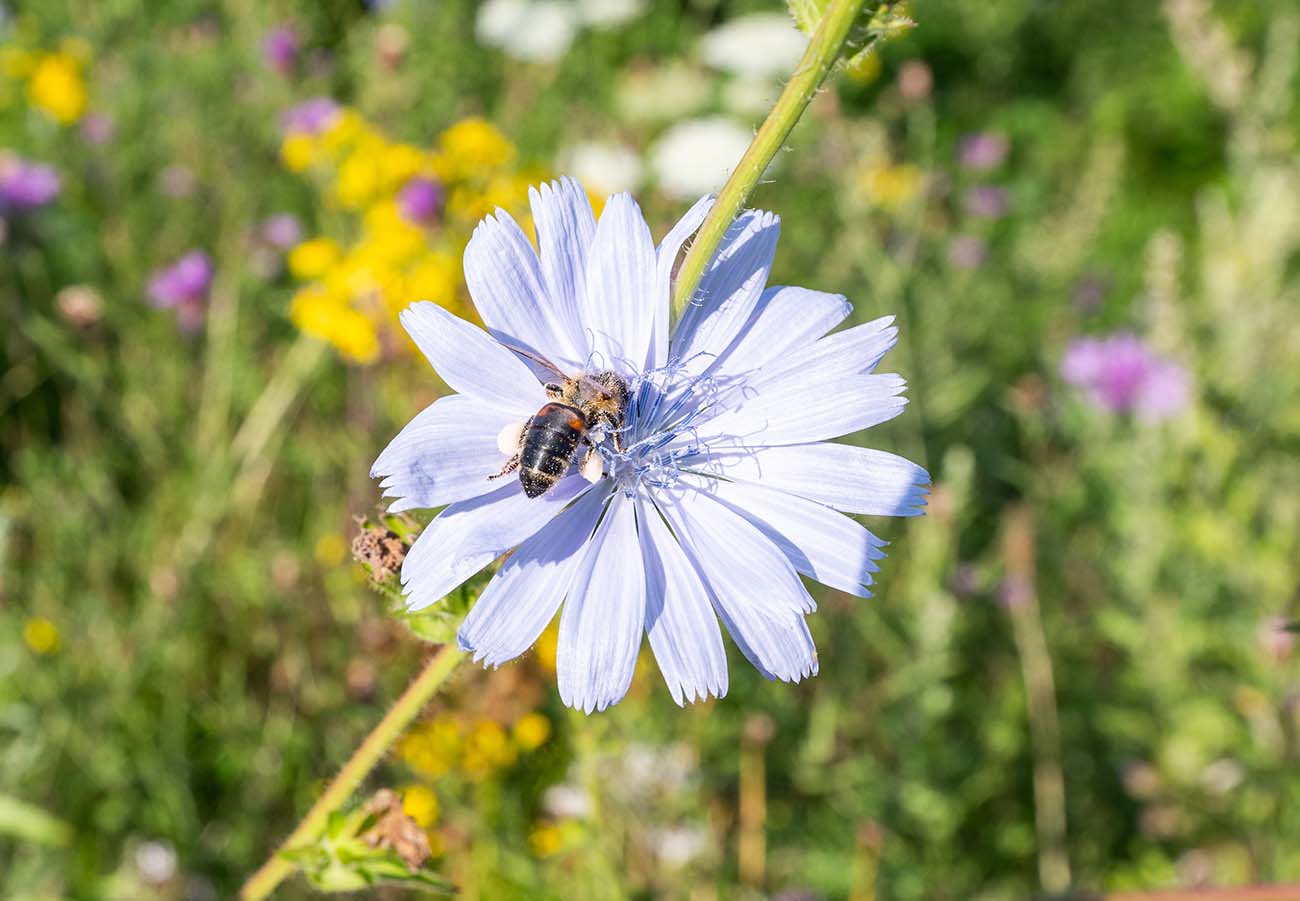
Wilde cichorei (Cichorium intybus) is een fotogenieke zomerplant. De hemelsblauwe bloemen vormen de perfecte weerspiegeling van een zomerse lucht. Die bloemen openen zich zodra de zon ’s ochtends gaat schijnen. Op een onbewolkte dag verwelken ze meestal al na een uur of zes. Op een meer bewolkte dag houden ze het wat langer vol. Gelukkig vormen zich van juni tot en met september voortdurend nieuwe bloemen aan de lange, vaak sterk vertakte stengels. Daarbij dragen die stengels maar heel weinig blad, waardoor de bloemen flink opvallen. “Overal langs den stengel schittert het blauw u tegen” schreven Frederike van Uildriks (1854-1919) en Vitus Bruinsma (1850-1916) in hun natuureducatieve boek Plantenschat (1890). En Uildriks voegde daar nog aan toe dat ze zich als onderwijzeres niet kon permitteren in een klas bepaalde kinderen voor te trekken maar dat onder de Nederlandse planten wilde cichorei “een echt favorietje” van haar was. Sprekende over de bloemen van de wilde cichorei kan nog worden opgemerkt dat botanici liever de term bloemhoofden hanteren. Wilde cichorei behoort namelijk tot de planten uit de composietenfamilie (Asteraceae). Wat zich bij oppervlakkige beschouwing voordoet als één bloem met 15 tot 20 kroonbladeren is anatomisch gezien een krans van 15 tot 20 zogenaamde lintbloemen. Een lintbloem is een gereduceerde bloem waarvan de bloemkroon is vergroeid tot een enkel bloemblad. Aan de vijf tandjes aan het uiteinde van elke lintbloem is te zien dat het om vijf vergroeide kroonbladeren gaat. Omdat wilde cichorei vaak in wegbermen groeit wordt de plant ook wel wegenwachter genoemd. De penwortels van de plant kunnen tot wel 75 cm lang worden. In gemalen en geroosterde vorm kunnen deze penwortels worden gebruikt als koffiesurrogaat en als smaakstof voor sommige soorten bier. Uit de wortels wordt tegenwoordig ook inuline gewonnen, een stof die de wortels beschermt tegen bevriezing. Inuline wordt onder andere als zoetstof toegepast in brood- en banketproducten en als prebioticum toegevoegd aan zuivelproducten.
|
COMMON CHICORY
Speaking of the chicory flowers, it should be noted that botanists prefer to use the term flower heads. Common chicory belongs to the plants of the composite family (Asteraceae). What appears to be, on superficial inspection, a single flower with 15 to 20 petals, is anatomically speaking a ray of 15 to 20 so-called florets. Ray florets are small, strap-shaped, marginal flowers whose petals have fused into a single one. The five teeth at the end of each ray floret show that there were originally five petals. Common chicory often grows along roadsides. That is why its popular Dutch name is wegenwachter, which translates as roadside guard. The plant’s taproots can grow up to 75 cm long. When ground and roasted these taproots can be used as a coffee substitute and as a flavouring additive in some types of beer. Nowadays, the roots are also used for extracting inulin, a substance that protects the roots against freezing. Inulin is used as a sweetener in bread and pastry and as a prebiotic in yogurts and other dairy products.
|